
Four chapters — a founding, a marriage, a friendship, and the bones beneath the grass.
Four chapters, roughly. A physician who went west. A frontiersman who stayed. A friendship that crossed treaty lines. And a hillside of bones older than memory.
A Ten-Minute Read · Drawn from Family Papers & Kirk Meade's Agate Springs
The ranch was founded by Dr. Elisha Barker Graham, a physician from Cheyenne, Wyoming Territory, and his wife, Mary Eliza Hutchison Graham — just six years after Custer fell at the Little Bighorn. Trained in medicine in Cleveland, Graham practiced twelve years in Three Rivers, Michigan, and then briefly in Albany, New York. Overwork thinned his health. In the mid-1870s he went west for altitude and air, and stayed for the grass.
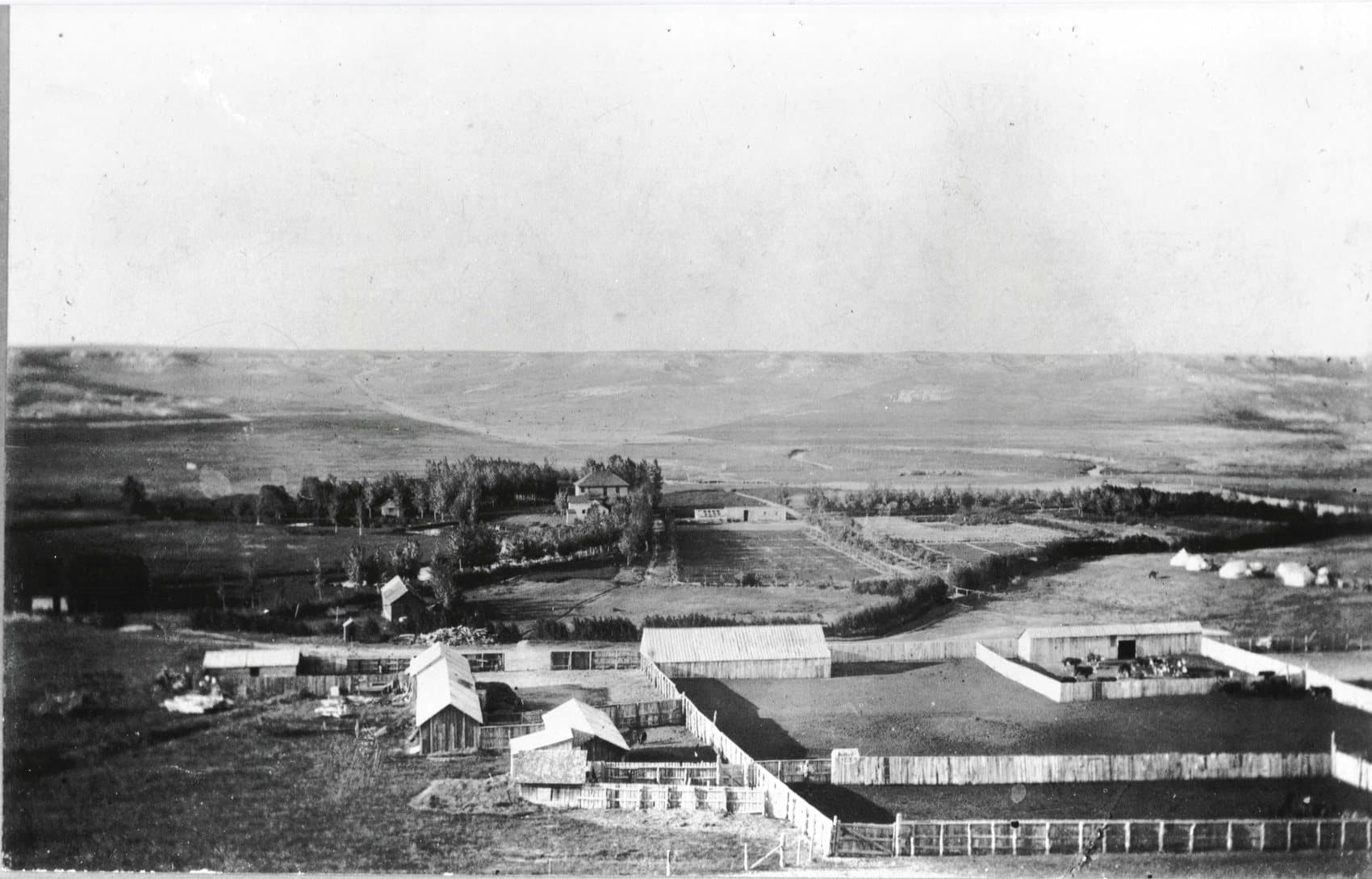
Two of his Cheyenne patients — John “Portugee” Phillips, the rider who carried the distress message from Fort Phil Kearny after the Fetterman Fight, and Hugh Orr, then Mayor of Cheyenne — told Graham of a spot on the Niobrara in Sioux County with plentiful grass and good water. In the spring of 1878, they conducted him to it. He arrived with 5,000 cattle, and branded them 04, for the nearby fourth meridian. The ranch sat just above the Niobrara crossing of the Fort Laramie–Fort Robinson military road.
The country was then open range and unsurveyed. There were no trees in the valley — only blowing sand churned by bison, antelope, and deer at the water's edge. Under foreman John “Charley” Russell, the crew hauled logs thirty miles from Pine Ridge; by 1880 two log houses, a barn, stable, and corrals stood at the headquarters. Graham's only neighbor in the early years was Edgar Beecher Bronson, the author and cattleman, whose Lower 33 ranch lay on nearby Whistle Creek — the two were the first men to bring cattle to ranch land in Sioux County.
Graham had trained at the Cleveland Medical College, practiced twelve years in Three Rivers, Michigan, and briefly in Albany — but overwork broke his health. The Niobrara gave him altitude, dry air, and the open grass that filled his patients' advice. He worked the ranch through the drought-and-blizzard years of the 1880s, kept his Cheyenne medical practice running beside it, and — when Kate married a frontiersman who could actually run cattle — he sold out in 1887 and retired to California. He lived another ten years.
Graham and Mary Eliza had two daughters. The elder, Clara, born in New York, would grow up to become, by some accounts, the first woman ever elected to the Wyoming State Legislature — a thread of Graham-side history worth more than the parenthesis it usually gets. The younger, Kate, born in Michigan, would marry a young frontiersman named James Cook and carry the ranch forward.
When Dr. Graham brought his five thousand head north from the Ogallala trail in the spring of 1878, he burned a simple mark on the left hip of every animal: a zero and a four. Local tradition holds that he took the figures from the Fourth Guide Meridian of the old Nebraska public land surveys — the surveyor's north-south line that ran down the country just east of the ranch. Whether the brand really came from the meridian or simply from the order in which Graham filed his brands in Laramie County that spring, the mark stuck.
The brand is also the reason the ranch carried two names at once for most of its early life. In Cook's memoirs and letters he calls it “Agate Springs”; in cattle-country correspondence, railroad shipping manifests, and neighbors' diaries, it shows up as “the 04.”
He knew the trail, the Army, the country, and the people on it — and he had the rare gift of being trusted by all of them.On Captain James H. Cook
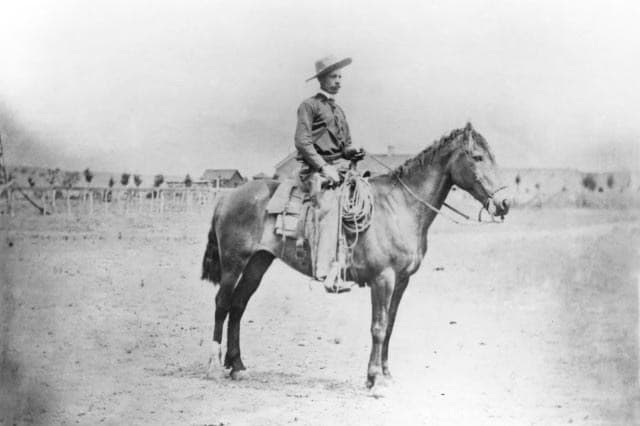
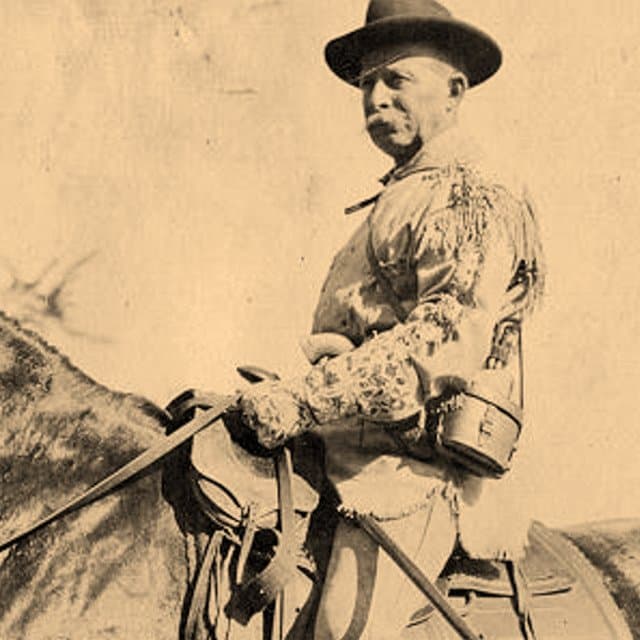
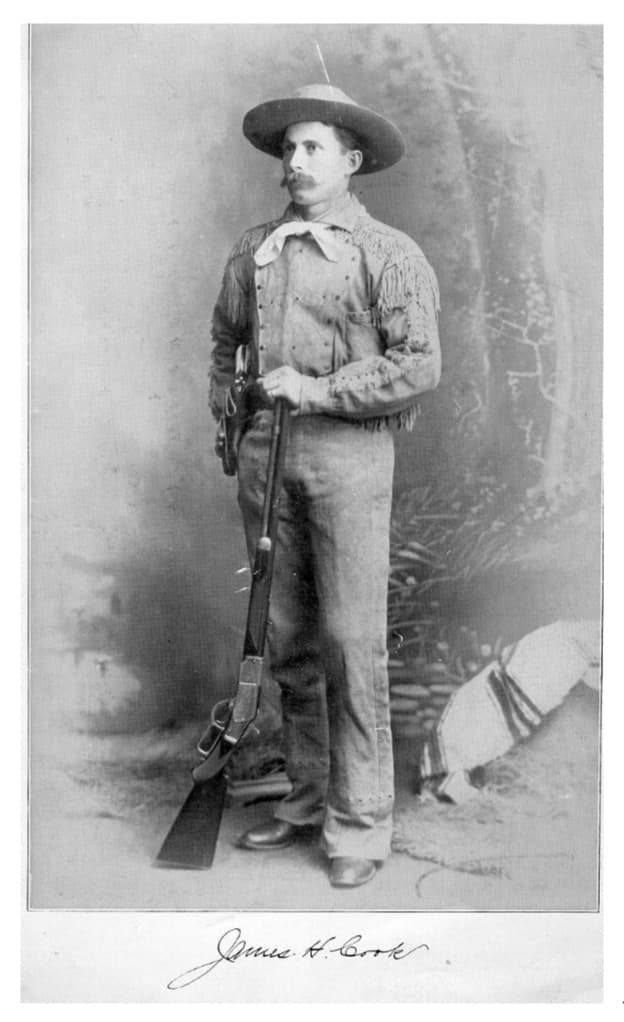
James Henry Cook was born in Kalamazoo, Michigan, in 1857. His mother died when he was two; he was raised by Quaker foster parents, and at eleven or twelve he ran off to try his luck on the Great Lakes. It didn't take. He went south and west, bought a horse for fifteen dollars in Leavenworth, and drifted into Texas, where American cowboys were then still learning their trade from the Mexican vaqueros. He apprenticed on the Llano Estacado — running wild cattle out of the brush country and driving them north to the railheads in Kansas and Colorado.
In 1874 he came up the trail to Nebraska. He was seventeen. At Fort Laramie he met O. C. Marsh, the Yale paleontologist and first American university-based scientist in his field, who was looking for fossils in the region and needed someone to translate his questions to the Oglala Lakota. Cook had picked up enough of the language on the trail to do the job. Two years later, in 1876, he asked Baptiste “Little Bat” Garnier, an Indian scout at the Red Cloud Agency, to introduce him directly to the chief — Cook needed permission to collect fossils in Sioux territory. That was how, as a young man, he first sat across from Chief Red Cloud — Makhpiya-Luta — who at that point was remembered most of all as the only Native American leader ever to direct a successful war against the United States.
Both friendships lasted the rest of Cook's life. He came to know Red Cloud so well that, years later, the Oglala tried to have him appointed as their official Indian Agent — a request the U.S. government declined. Historians have written that he probably knew Red Cloud better than any other white man of his era.
In the decade that followed, Cook scouted for the U.S. Army during the Apache Campaign of 1884 on his war horse Curley, managed a ranch in New Mexico, worked as a market hunter out of Colorado and Wyoming supplying the railroads and hotels, and built a second career guiding hunting parties in the Rockies for English aristocrats and American gentry. But he kept coming back to Nebraska, where a doctor's daughter named Kate Graham was waiting.
They were married in 1886, and in 1887 bought her father's 04 Ranch. Cook renamed it Agate Springs, after the moss agate he'd found near the river. He planted the cottonwoods that still shade the headquarters — watering every tree by hand until it was established — and opened his door for five decades to the Lakota. In the course of those years he wrote three books: Wild Horses of the Plains (1919), Fifty Years on the Old Frontier (Yale, 1923), and Longhorn Cowboy (published posthumously in 1942, the year he died). He was inducted into the Cowboy Hall of Fame in 1960.
The Captain passed at Agate in 1942, eighty-four years old. Ranch, museum, brand, and a half-century of correspondence all passed to his son Harold — and the chapter on Kate, who had made the place a home, is told just below.
He had lived four lives before he was thirty — trail hand, scout, hunter, guide — and he still had fifty years of ranching ahead.On James Cook's Arrival at Agate
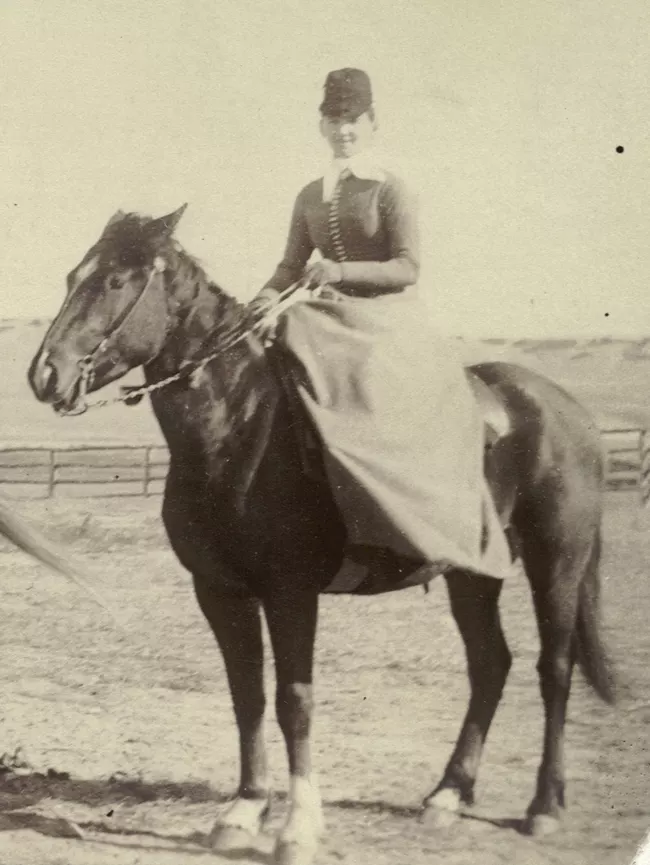
Kate Graham was Dr. E. B. Graham's younger daughter — a scholar and musician, educated at the University of Nebraska, who taught herself French so she could read French literature in the original. She was also a formidable horsewoman. One afternoon in Cheyenne, to win a bet for James, she rode a bucking horse through the streets sidesaddle. At the ranch she often rode Billy American Horse, a gift from the Oglala leader American Horse.
She met James Cook in Cheyenne and they married on September 28, 1886. Their first home was in New Mexico, on a ranch the Captain managed; they soon returned to Sioux County to buy her father's 04 and rename it Agate Springs Ranch. The Cheyenne papers followed the romance closely enough that Kate's scrapbook of clippings later became the principal source for historians of the ranch.
It was Kate, riding alone or with James through the hills near her father's headquarters, who first came across the fossils. She carried the bones home and showed them to the Captain, who eventually wrote to the paleontologists. In that sense she is, properly, the first discoverer of the Agate fossil beds — a distinction the historical record has sometimes obscured.
In September 1887 she brought her infant son Harold and her widowed mother Mary Eliza Graham to the new ranch on the Niobrara. A second son, John, followed. Kate ran the household and raised the boys against a backdrop of wolves, rattlesnakes, and ranch debt. When the Captain built the new ranch house in 1892, Kate designed it and travelled with him to the Chicago World's Fair to choose the rugs, curtains, glassware, silver, and china — all freighted by rail to Marsland and hauled the last miles by wagon.
Mental illness overtook her in 1909 at age 41 and she was confined to a sanitarium in Lincoln, where she remained for the rest of her life. Dorothy and Winifred visited her there as young adults. After decades in the institution, Kate was lucid enough to greet them with, “You must be Harold's daughters.”
She is why the house holds the shape it holds, why the boys and their children could ride the country as their own, and why the fossils were noticed at all.
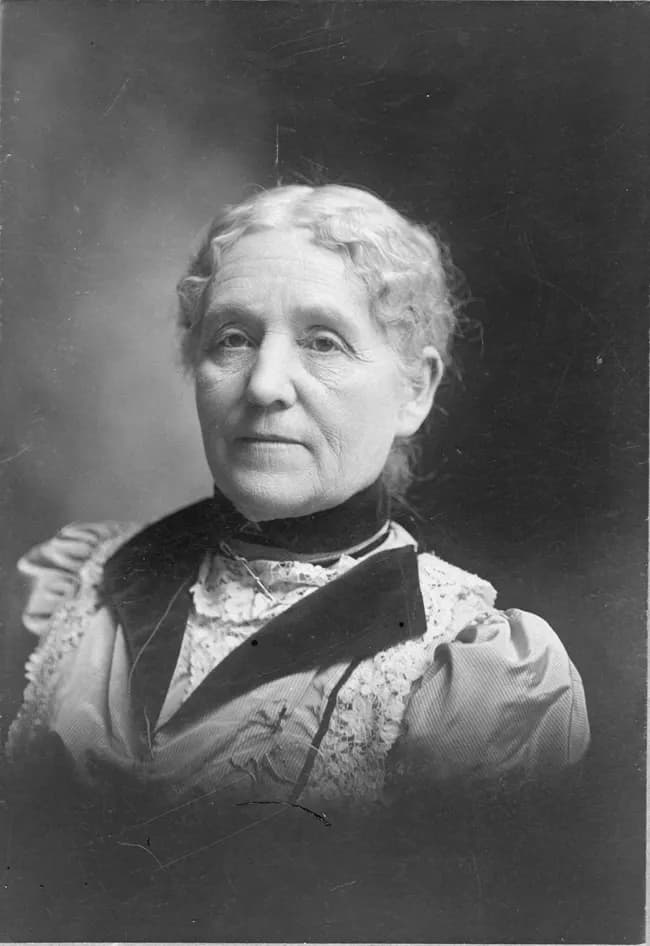
Mary Eliza Hutchinson Graham was Kate's mother and the ranch's quiet founding woman. Raised on a Michigan farm in the craft economy of the mid-nineteenth century, she could spin, weave, dye, sew, cook, preserve, make candles, and churn butter — the full repertoire that would carry her through frontier life. She was also, perhaps unexpectedly, active in the women's suffrage movement alongside Susan B. Anthony.
In 1861 she moved with Dr. E. B. Graham and their two daughters, Clara and Kate, from Three Rivers, Michigan to Cheyenne for the doctor's health. When he began homesteading on the Niobrara, the family divided its time between Cheyenne and the 04. Mary, Clara, and Kate were the first women to make a permanent home in Sioux County. She later moved in with Kate and James after the ranch changed hands, and she ran the household through the Captain's long absences.
In 1892 Mary Eliza was appointed the first postmaster at the Agate Post Office and, the same year, kept the first official weather station at Agate. She also led Sunday services for the cowboys, delivered babies, and nursed pioneer mothers through the dangerous hours of childbirth. Her last years she spent in California near her older daughter Clara Heath. She lived to ninety-six — a long, steady, useful life at the center of everything that made Agate a place.
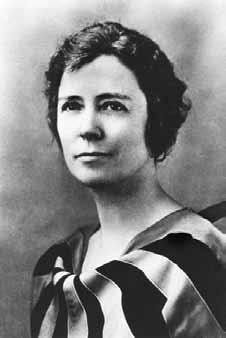
Eleanor Barbour grew up in a scientifically active household — her father E. H. Barbour was director of the Nebraska State Museum at the University of Nebraska, the same man who had named the Devil's Corkscrews at Agate. Eleanor had a distinguished record at the University, studied abroad, and brought to the ranch an education rare for any woman of her generation, with passions in geology, paleontology, and music.
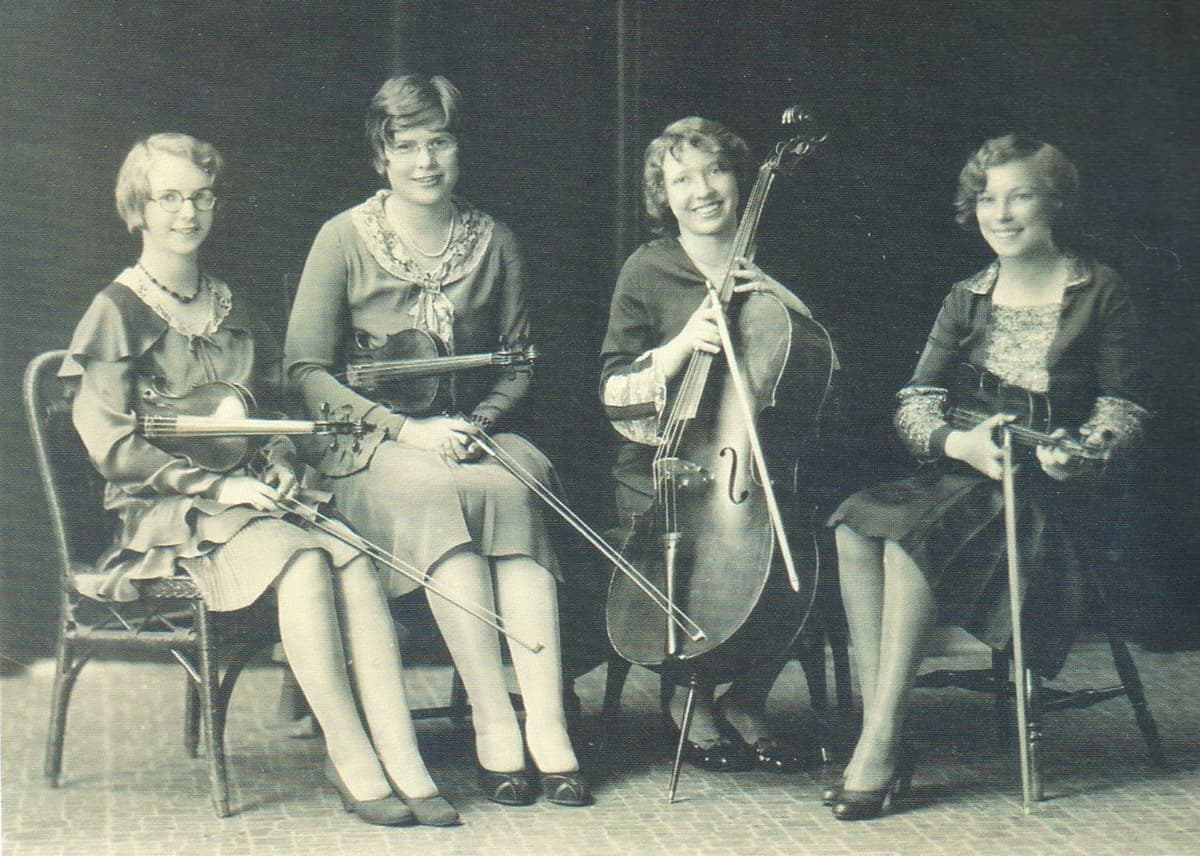
Through her father she met Harold Cook, whom she married in 1910. They lived at “Agate East,” on what is now the National Monument, through the heyday of the fossil quarries. She threw herself into her peculiar double role — part housewife and mother, part scientific colleague — with intelligence and humor. Their four daughters — Eleanor Jr., Dorothy, Winifred, and Margaret — all grew up in the quarries, helped the paleontologists, learned at the dining-room table under Eleanor's teaching, and went on to the University of Nebraska.
After she and Harold separated in 1922 (divorcing in 1929), Eleanor taught English, geology, and paleontology at Nebraska State Normal College in Chadron — now Chadron State College — and, at the college president's request, gathered the geological and paleontological collections that opened the college's Museum of Geology. She became the museum's first curator. It carries her name today: the Eleanor Barbour Cook Museum of Geology.
Her daughter Margaret and Margaret's husband George ranched on the Niobrara within sight of the Fossil Hills. Dorothy and her husband Grayson Meade moved into the ranch house in the fall of 1972 and lived there until their deaths in the mid-1990s. There Dorothy wrote three short books about the place.
Cook's deepest and most enduring friendships were with the Oglala Lakota. He first met Chief Red Cloud in 1874, at the Red Cloud Agency in what is now the Nebraska panhandle. Cook was seventeen, already well-regarded as a hunter and guide. Red Cloud was fifty-three — chief of the local Oglala band and, by that point, the only Native American leader ever to have directed a successful war against the United States. They were introduced by Cook's friend Baptiste “Little Bat” Garnier, a scout who lived at the agency. Something clicked. Over time the Lakota would give Cook a name — Wambli Cigala, Little Eagle — and sing songs about him on the long ride down from Pine Ridge.
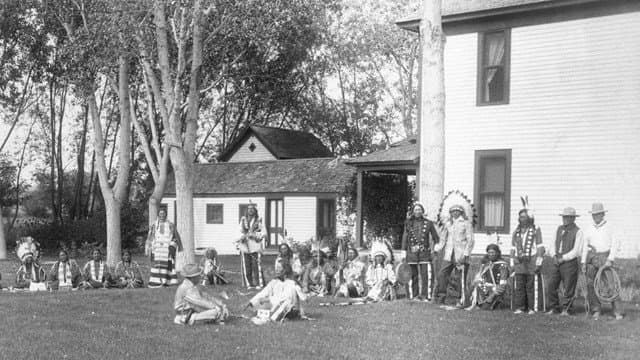
After the Oglala were confined to Pine Ridge in South Dakota in 1887, Cook obtained the passes for three decades so they could come south to Agate. The ride was ninety-five to a hundred and fifty miles, three to five days of wagons and horses, and they wound down the last hill into the Niobrara bottom singing. On the flats east of the ranch house they set up tipis and, for a week or two at a time, returned to the old ways — hunting pronghorn, tanning hides, holding ceremonies, and, joined by Cook, recounting the stories of earlier years for hours. Cook provided fresh beef and vegetables; they brought gifts in return.
In 1902, the artist Bessie Butler came out to the ranch to paint Red Cloud's portrait — the painting that still hangs in the collection today. Six years later, in early May 1908, Red Cloud made his final visit. He was eighty-five or eighty-six, by his own reckoning close to death, and it was understood by both sides that this would be the last trip.
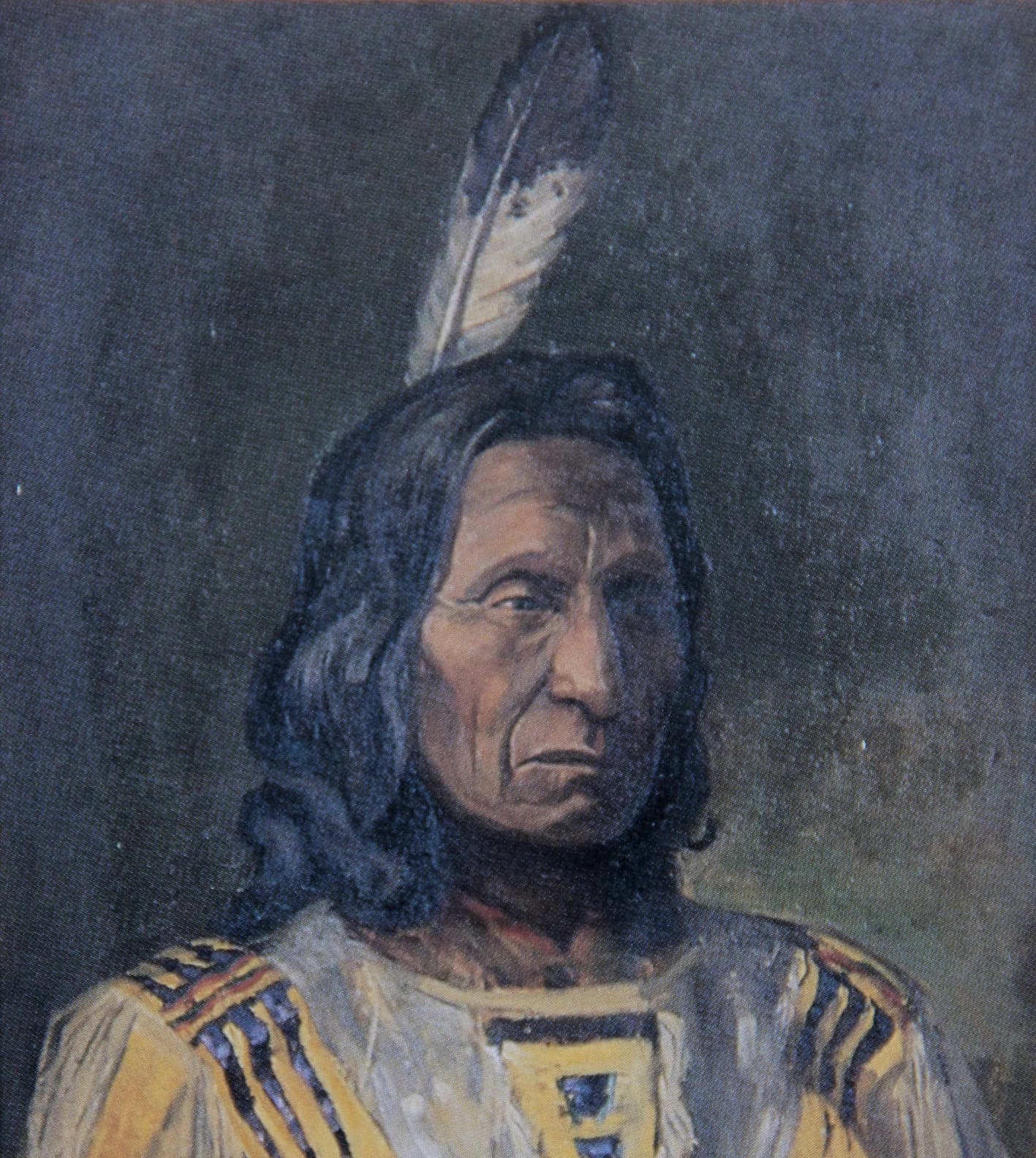
I want you to always own and keep that picture — as long as you live, and then let your oldest son have it to keep. Then I am sure my children and their children can always go and look at the face of one of the last of the old Chiefs that lived before the white men came to take our lands and turn us from the old trails we had followed for so many hundreds of years.
I will soon go to join my old friends, and now on my last visit to you my friend I want to say, through my nephew and interpreter Mr. Phillip Romero, that in you I think my people will always find a true friend, and I want them to listen to your words of council.
Red Cloud died the following year, in December 1909. The antelope-hide war shirt he had worn for the portrait rests today in the visitor center of Agate Fossil Beds National Monument, a few miles east of the ranch.
There is one more scene, from the summer before that last visit, that captures what the friendship had become. In September 1907, the Cooks' eldest son Harold — then twenty — was leaving home for the first time, to attend school in Lincoln. James Cook described what the Lakota, camped as always in their lodges about a hundred yards from the ranch house, did when they learned the boy was leaving:
When the conveyance drove up which was to take him away, the old Indian women lined up on each side of the walk leading from the door to the driveway; and as my son passed between them, each woman gave him a handshake, and then all began to chant the songs which they sing when they part from their own kinsmen.
When the carriage passed the Indian camp, all the men came out, dressed in the best they owned, old Red Cloud taking the lead. The aged chieftain took my son in his arms and held him close, placing his cheek against the boy's and patting his back, and he said: “I am an old man. Your father is my friend. I and my people will give you his name and think of you with good hearts.”
All the men came forward and embraced the boy, whose eyes by this time were dim with tears, as were those of a number of both the red and the white women who witnessed the scene.
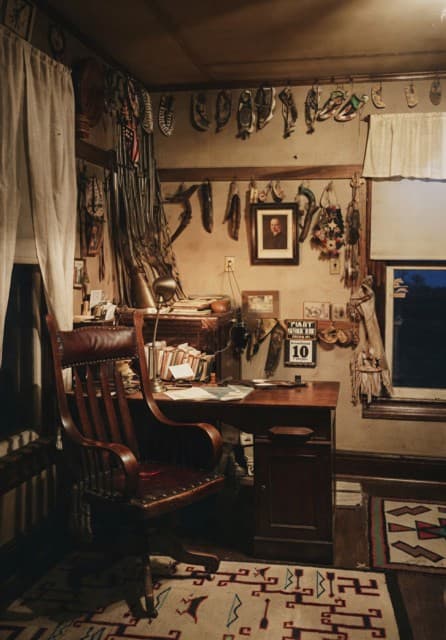
Pipes, beadwork, ledger drawings, tanned robes, a painted hide of the Battle of the Greasy Grass — the gifts accumulated over fifty years are known as the Cook Collection: roughly five hundred pieces, one of the finest family-assembled collections of Plains Indian material in North America.
By the 1920s the Cooks had turned three rooms and a hallway of the ranch house into the Cook Museum of Natural History. Harold, home from his paleontological work in the East, displayed many of the Lakota gifts in what the family called the “bone room.” On summer weekends, James personally guided tourists through the fossils and the collection.
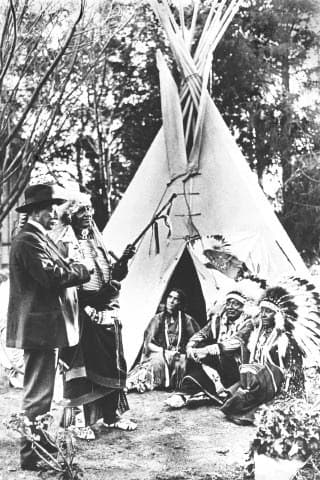
The white man can work if he wants to, but the Great Spirit did not make us to work.Chief Red Cloud · Oglala Lakota
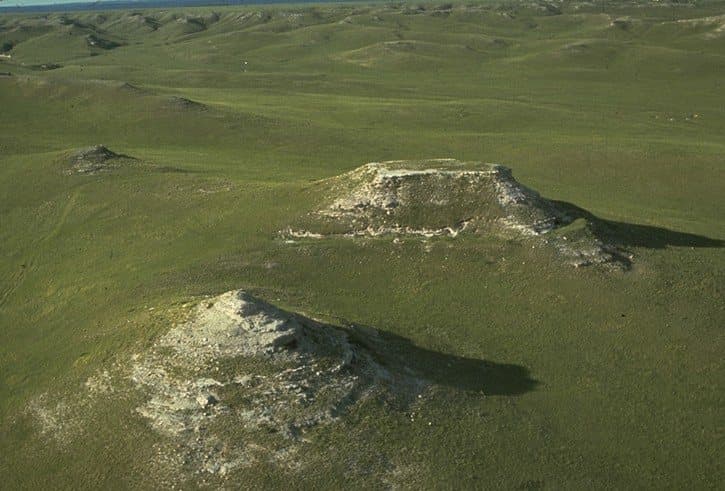
It was during their courtship in 1878 that James Cook and Kate Graham first came across the bones. On a horseback ride from her father's ranch, they climbed two conical hills about three miles from what is now the headquarters. Halfway up, Cook noticed a glitter in the grass — a fragment of fossilized leg bone, its marrow cavity filled with calcite crystals.
It took fourteen years for anyone from the outside world to listen. In 1892, Erwin H. Barbour of the University of Nebraska finally came out to see what Cook kept describing in his letters — strange spiral structures in the sandstone bluffs that no one had been able to explain. Barbour named them Daemonelix: the “Devil's Corkscrews.”
What followed was one of the great fossil rushes of the early twentieth century. The hills above the ranch house — now called University Hill and Carnegie Hill — gave up the most complete skeletons of Miocene-era mammals ever found in North America.
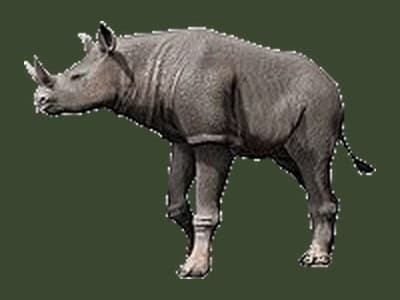
Pony-sized, paired-horned, and abundant in the Agate quarries. The Miocene plains teemed with them.
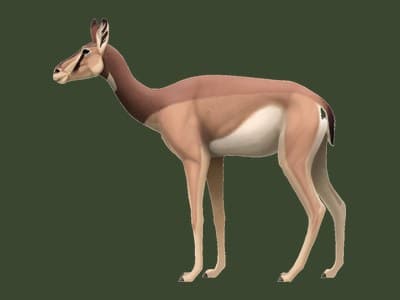
A slender, deer-like camel that grazed the Nebraska savanna twenty million years ago.
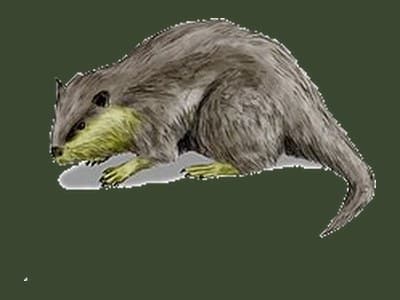
A dry-land beaver whose helical burrows baffled paleontologists for a century.
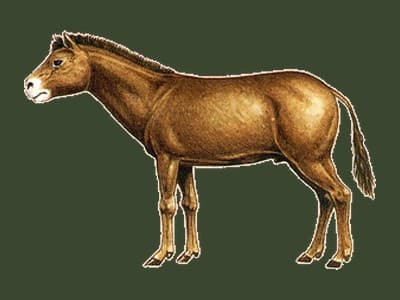
A dog-sized ancestor of the modern horse. Its skeletons from Agate still illuminate equine evolution.
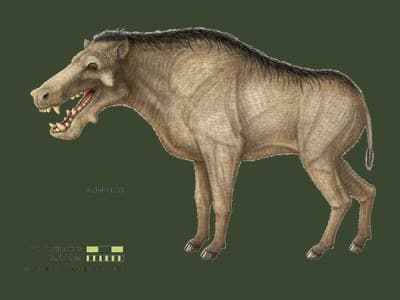
A bison-sized entelodont, perhaps the most fearsome predator-scavenger of the Miocene plains. Its enormous skulls from the Agate quarries are among the Monument's signature fossils.
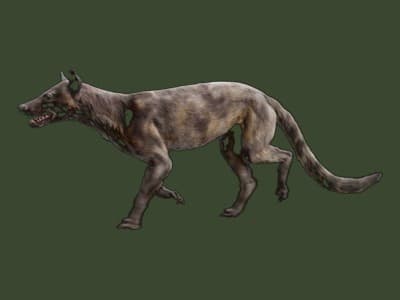
An early carnivoran blending traits of bears and dogs, pack-hunting the Miocene floodplains. The Agate specimens helped define the family.
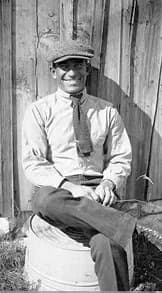
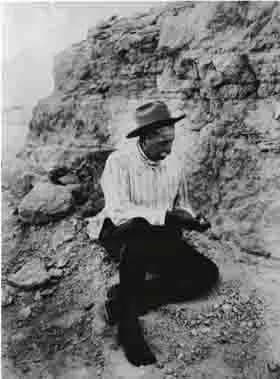
Harold James Cook was born at Agate in July 1887 — the same year his parents bought the ranch. He was five years old when he helped Barbour lift his first Daemonelix out of the sandstone. He never stopped. He taught geology at the University of Nebraska before he was formally enrolled there, then went to Columbia under Henry Fairfield Osborn of the American Museum.
Paleontologists named an ox-sized twin-horned mammal Syndyoceros cooki in his honor. He published more than fifty papers. He served as Curator of Paleontology at the Colorado Museum of Natural History, as first custodian of Scotts Bluff National Monument, and as president of the Good Roads Association that brought Highway 29 through Agate.
He died in 1962. Three years later, in 1965, the quarry land was donated by the family to the National Park Service and became Agate Fossil Beds National Monument — a permanent home for the bones, the Cook Collection, and the story of the family that kept them safe.
When Harold homesteaded the 640-acre parcel containing the fossil quarries in 1914, he built a small cabin at its edge for himself and Eleanor. It was where they lived in the years the quarries were still active — a field station, a fossil workshop, a writing desk, a home.
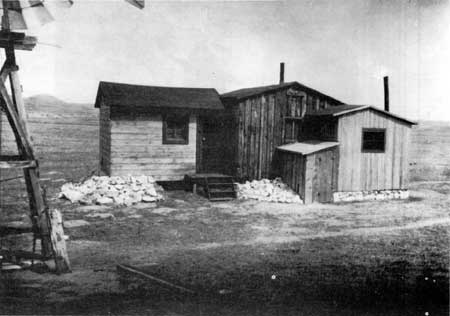
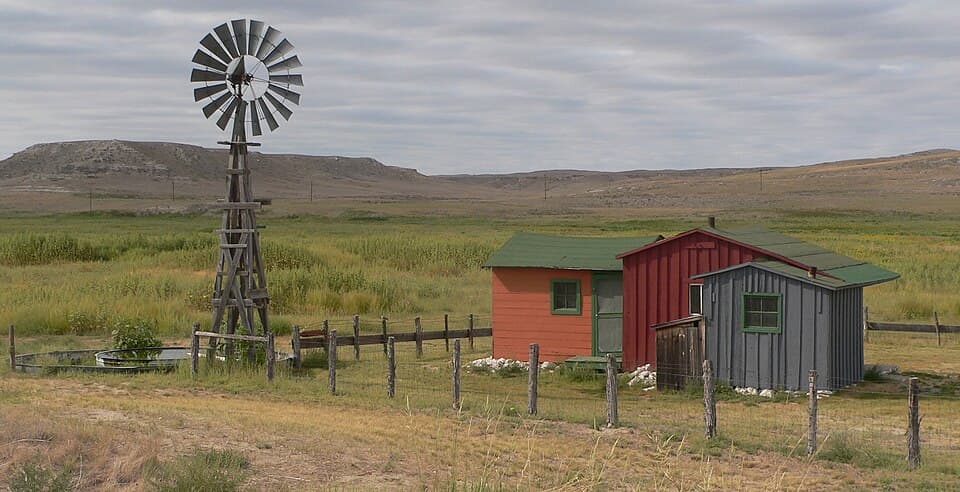
Harold J. Cook died in September 1962. He left the ranch land to his four daughters by Eleanor Barbour — Margaret Hoffman, Winifred McGrew, Eleanor Naffziger, and Dorothy Cook Meade — and the remainder of his estate to his second wife, Margaret Crozier Cook. Margaret held a life estate in the land and ranch house. In 1965, the quarry land was donated to the National Park Service to create the Monument. Margaret continued to live quietly in the ranch house until her own death in August 1968.
Margaret Cook's will left her estate to her sister and two nephews in California, while allowing the National Park Service to select certain items from the house and outbuildings, including specific furniture and the Cook Collection. What it did not address was the dozens of ordinary family possessions that had been in the house for three generations — Kate's engagement ring, James Cook's turquoise, a chair James Cook's father had owned, the hand-woven woolen coverlets Mary Eliza Graham had made, the toys Harold and his brother John had played with as boys.
Win, El and I agree that we do not want any auction to be held at Agate. If Laura and Co. should make some gesture or suggestion, either toward simply giving us family furniture and possessions, or at least toward letting us buy what we want at the appraised price prior to public sale, then Win, El and I agree that we might be willing to accommodate their sale of household goods at the ranch, but not at the house under any circumstances, and not in the grove.
Dorothy wrote from Calgary, Alberta, where she and her husband Grayson E. Meade — a geologist — had been living. That fall she carried on a dense correspondence with the Scottsbluff attorneys and with her three sisters, trying to head off an auction on the property. As a counter-offer, Grayson and Dorothy proposed buying the entire contents of the ranch house as a single lump, at appraised value, so that nothing would be taken off the property and scattered to strangers.
A deal was struck. The Margaret Crozier Cook household goods were purchased for $1,000, with the purchase price split evenly between Dorothy and Grayson Meade and Eleanor C. Kottke. The family preserved the contents: chairs, rings and brooches, Mary Eliza's hand-woven coverlets, childhood toys, portraits, books, and other things that held the family story. The items were shared among the four sisters.
At the same time, the estate sold all the cattle, and an auction of the ranch machinery and equipment was held in November 1968. The sale stripped the ranch of nearly everything needed to operate it — not even a screwdriver remained. The four sisters were left with the land itself, and even part of that faced possible condemnation by the National Park Service.
Still, they decided to keep the ranch and return it to working order. They found it badly neglected. Fences were sound only where they could be seen from the house or highway, while coils of barbed wire lay scattered and sometimes half-buried throughout the meadows. The corrals and outbuildings had deteriorated, and there was no suitable place for the cows to calve.
Dorothy and Grayson Meade, together with Eleanor and other members of the family, spent their vacations at Agate tackling the most urgent work. Kirk, Evan, and Constance Meade worked many summers in the hayfields without pay.
The sisters initially financed the operation themselves. Henry W. Smith also loaned them money to purchase equipment. They hired Jerry Griesse to manage the ranch and acquire cattle — some purchased from George Hoffman — and the machinery needed to operate the ranch. George loaned the ranch equipment that was later purchased, while Margaret Hoffman took responsibility for keeping the grove mowed.
Relations between Jerry and the Hoffmans became strained, while the National Park Service continued pressing to acquire more land. In November 1972, Dorothy and Grayson moved to the ranch to help forestall condemnation and relieve Margaret and George Hoffman, both in poor health, of further responsibility. They lived there until their deaths in the mid-1990s.
During 1973, Dorothy devoted herself to preserving as much of the ranch as possible. By year's end, she had reached an agreement with the National Park Service that preserved most of the East Meadow and the ranch headquarters.
Grayson took on the demanding work of operating the ranch. That same year, he and Dorothy met Jim Skavdahl, whose advice quickly became invaluable. Jerry eventually left, and a succession of foremen managed the ranch until Steve Westoverwas hired.
From then on, improvements were made each year to restore the ranch and make it an efficient working operation. In early 1978, Jim Skavdahl took over its management on a handshake. The arrangement was formalized with a lease some ten to fifteen years later.
Years later, after Eleanor C. Kottke's death, Dorothy Meade paid Eleanor's daughter, Polly Rago, $500 for Eleanor's half interest.
The ranch house also became Dorothy's writing desk. The three books she produced there — The Story of Agate Springs Ranch, the History of the Agate Post Office, and Heart Bags and Handshakes — are the primary family accounts of a place that, without the 1968 intervention, would have been emptied out at auction and dispersed across the plains.
What followed was the arrangement still in force today. The four daughters' heirs gathered the land holdings into a family partnership, and the ranch house and grove were kept intact. The Skavdahl family continues to operate the working Angus ranch as long-standing tenants, carrying forward the tradition the sisters chose to preserve.
The ranch holds the bones, the brand, and a hundred and fifty years of the family's weather.End of the Long Story